When does this process end? The maker’s eye is never satisfied, for he knows that each
word in his copy is tentative.
Both pieces deal with the same topic – writing is a process. One that should be taken seriously yet let yourself be vulnerable and be “your best enemy” (Maker’s Eye). Do the work. It will often not come as an epiphany or a dash to finish. It will be written, edited, practiced, revised – writing and teaching practices. I wrote that portion when reading the There, I said it. Again piece earlier in the day. In The Maker’s Eye, Murray describes his seven elements of the writing process. The process as a whole could be broken down any which way and in various number of pieces. Anne Lamott describes one writer as writing an elegant first draft, but not many do. Some writers love dictating their drafts, others write on typewriters, R.R. Martin writes on old Dos operating system I’ve heard, one writer researches everything on 4×6 cards and categorizes them in a “commonplace book” before weaving those ideas all together. The point is everyone writes using a different system and most of the time it employs hard work.
I would be interested to see “classics” or “masterpieces” from writers and artist who have since passed away be critiqued by their creator. What would they change and where? People change as they mature – perspectives mature and that may show in the work. Others might choose to leave everything as is because that work is important as a reflection of who they were at that time.
In The Maker’s Eye, I am not sure if it was a cheeky, on purpose move, but there seem to be quite a few typos. It could be the person adapting it to this format, or the editor missed but I like to think it was Murray’s intention.
I don’t want to take anything away from a writer; however, some writers seem to follow a formula (I am also guilty of this) to fulfill a book contract, make more money, or just simply to write. John Grisham used to be a lawyer and once he became a full-fledged writer, he turned to what he had expertise in. His older books were best-selling (still are) and made into box-office smashes starring Tom Cruise and Harrison Ford. As time continues you see the same pattern and might become bored. This might seem like I am bashing Grisham and other “formulaic” writers, but one of my favorite books of all time was written by him. It was a book written outside of the world of law and conspiracy – a coming-of-age story about a boy growing up on a farm in Arkansas listening to his St. Louis Cardinals trying to close the gap on the hated New York Yankees. While this book was semi-autobiographical, he went from writing for the sake of writing (it seemed like – I could definitely be wrong) to writing because he had something to say.
Someone has said, “a single most important tool for a writer (artist) is their trash can.” I feel like Anne would agree with this statement. While the writing might be trash – it does not mean it is useless and you throw it away. Throw it away, take a break, walk by the bin, remove the crumpled piece of paper and get back to work. Writing this makes me laugh because it seems like such a romanticized picture of the writing process, but it’s probably happened to more than one person in the world.
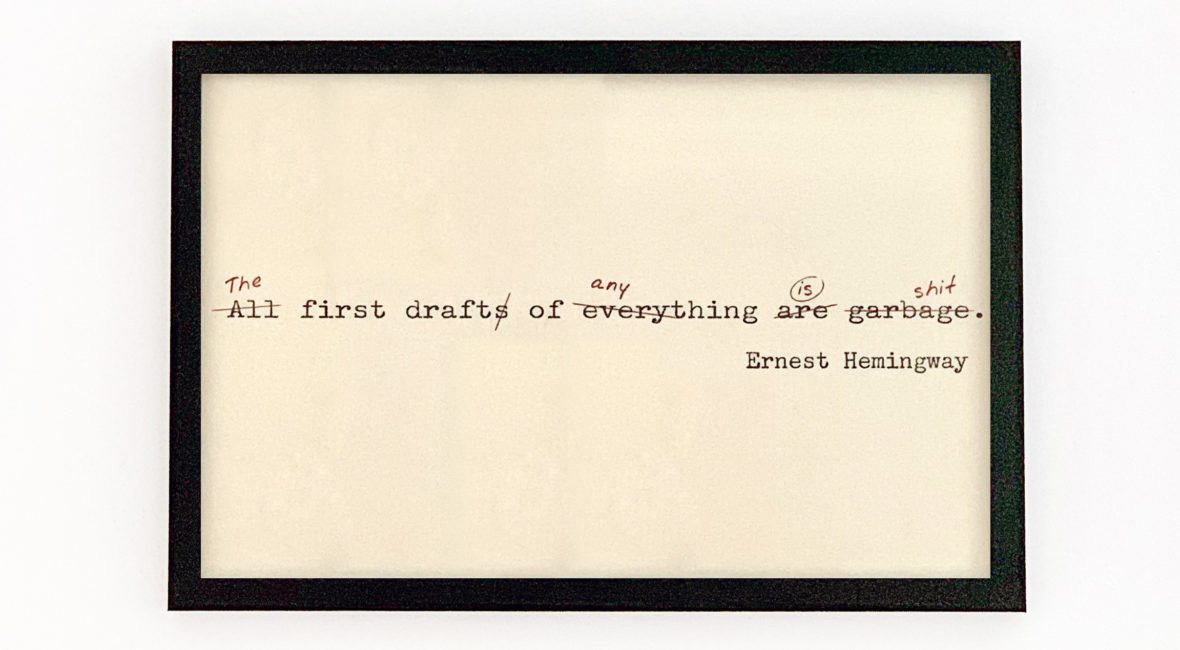
The picture above from Ernest Hemingway was from a blog post of an author I follow. He wrote on a similar topic and I had to go back and re-read to see how similar or different his idea was from Lamott or Murray. He opens the post with this:
Young aspiring writers love the story of Jack Kerouac, who supposedly wrote On the Road in a three-week drug-fueled blitz. What they know less about is the six years he spent editing and refining it until it was finally ready.
I am pretty sports oriented. If I stated this athlete just took up [enter whatever sport] and got the gold medal you would never believe me. It is similar with writing and authors. Even if you did have a spark of ingenuity and wrote some beautiful prose, you do not want to be a flash in the pan. You want to work hard and hone your craft so you are able to write and re-write. You want to further yourself as a writer/creative. No one wants to be a one-hit wonder. Even with the one-hit wonders, it is very unlikely they did it themselves in 30 minutes. They still needed to master, mix, and produce the record which took multiple people’s expertise and involvement. One added thing about the post which he talks about (and is not fully developed in Murray or Lamott) is this:
Nobody creates flawless first drafts. And nobody creates better second drafts without the intervention of someone else. Nobody. Not even you.
I like to think the intervention may not even be direct. While editing or revising on your own you might think back to a conversation you had with a friend or a mentor or in a professional development class like this one. It might alter your whole message or just clarify a few lines – either way it was improved upon.


I would almost agree with everything that you said – except I did feel that both Lamott and Murray addressed the idea that no first draft is perfect. I really pulled that idea from each article. I like how you incorporated other fields of study (especially sports) into the discussion. Why is it that we are so easily convinced that good writing is easy, yet revolt against the idea that athletes have remarkable talents that makes winning easy? That would be a good analogy to use with students! They see writing as an insurmountable task – too difficult, too overwhelming, and too unobtainable. Yet I think we could sway them a bit to our side by using that analogy. I like to tell my kids that nothing worth having is easy, and that the only way to achieve great things is through effort. Again, as I am typing this I am thinking about how this could be used with my students. Writing can be hard, but I think we need to push them away from the idea that it is a rigid process – that they must follow the rules to create good pieces of writing. Maybe that is why so many students feel that the task of writing is too hard – because they cannot genuinely follow the “steps.”
LikeLike
There are so many things about this I want to respond to! I will begin (literally) from the top!
1) I love the Hemingway quote with which you chose to start your blog. That’s so applicable here!
2) I feel like the trash can is also an important reminder for students because not everything is going to be perfect and not everything written has to be a full formal essay for grading. Sometimes I will take students quick writes (after reading) and ask if anybody wants it back, otherwise it’s getting recycled. YOU SHOULD SEE THEIR FACES. They are AGHAST that I am not grading and recording every single thing they’ve written. WHY DID WE WRITE IT THEN? For the experience, my children…
3) I hadn’t heard the 3 weeks for On the Road, but knowing it took 6 years to perfect it makes me feel better haha. I wonder if he hadn’t been all hopped up if it would have taken less time to edit…. 🙂
LikeLike